How Texas UV Rays Fade Wood Fences Faster Than You Think
You spent good money on a wood fence. It looked beautiful when it went up, that warm, rich tone that made your whole yard feel complete. Then a Texas summer happened. Within a year, maybe two, that color started washing out, the grain started roughening up, and now you’re looking at something that resembles driftwood more than a quality fence. This isn’t a coincidence and it isn’t bad luck. It’s the Texas UV, and it happens to nearly every unprotected wood fence in the region. At Woodcrafters Fencing, we’ve seen this story play out hundreds of times across the area, and we built our professional fence staining service specifically to stop it before it starts.
Why Texas UV Exposure Is Uniquely Brutal
Texas sits at a lower latitude than most of the continental United States, which means the sun’s rays hit at a more direct angle for more hours of the day. On top of that, the state averages over 230 sunny days per year in many areas. For your fence, that’s 230 days of ultraviolet radiation breaking down lignin, which is the natural compound in wood that gives it structure and color. Once lignin degrades, wood turns gray, becomes brittle, and opens itself up to moisture damage, mold, and cracking. The Texas UV exposure doesn’t just change how your fence looks, it fundamentally weakens it.
The Fading You See Is the Least of Your Problems
Most homeowners notice the color change first and assume it’s a cosmetic issue. The graying and bleaching are actually warning signs of something deeper going on. As the wood surface breaks down, it develops tiny cracks and pores that absorb water during rain, then dry out in the heat.
That repeated expansion and contraction is what eventually causes warping, splitting, and rot. A fence that looks faded today could be structurally compromised within a few years if nothing is done. Research from the Wood Protection Association consistently shows that unprotected exterior wood in high-UV climates can lose significant structural integrity in as few as three to five years.
Why DIY Staining Often Falls Short
Walk into any hardware store and you’ll find rows of fence stains promising UV protection. The products themselves aren’t the problem. Application is where most DIY projects run into trouble. Professional staining starts with proper surface preparation, which means cleaning, sanding, and in some cases chemically treating the wood to open the grain so the stain actually penetrates rather than sitting on top.
A stain that sits on the surface instead of bonding with the wood will peel, crack, and wash away far sooner than one that’s been properly applied. Without the right prep and the right technique, you can spend a full weekend on a project that needs to be redone within a season.
What Professional Application Actually Does
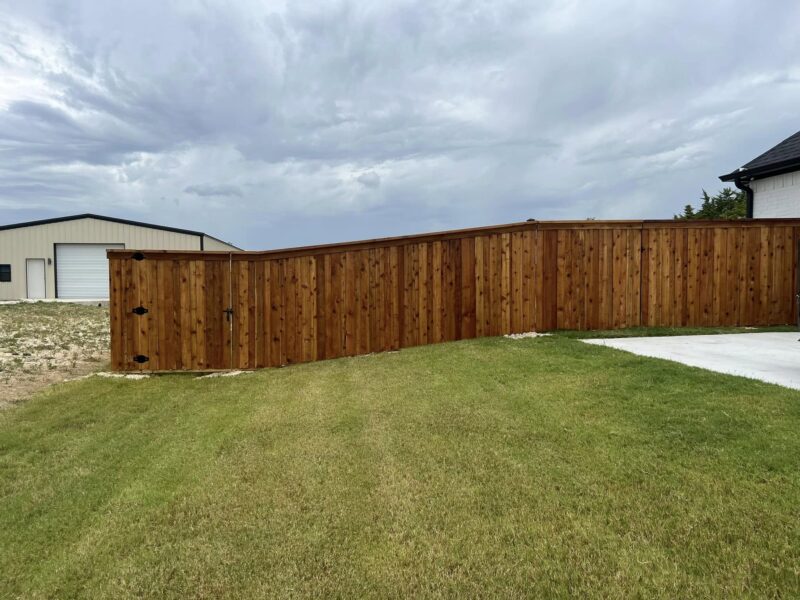
Woodcrafters Fencing uses penetrating oil-based stains that are specifically formulated for high-UV environments. These stains absorb into the wood fiber rather than coating it, which means they move with the wood as it expands and contracts instead of cracking under pressure. The result is protection that lasts significantly longer, typically three to five times longer than a surface-level DIY application, and a finish that maintains its color instead of fading to gray after a single summer.
The Investment That Pays for Itself
A full fence replacement in Texas can run thousands, depending on size and materials. Professional staining costs a fraction of that and, when done correctly, can extend the life of your existing fence by a decade or more. The math isn’t complicated. Protecting what you already have is almost always more cost-effective than replacing it prematurely.
Your fence is working hard every day against one of the most aggressive climates in the country. Give it the protection it actually needs. Reach out to Woodcrafters Fencing today for a free staining consultation and keep your fence looking and performing the way it should for years to come.